Don’t Equate Nazi Collaborator and Proven Jew Killer
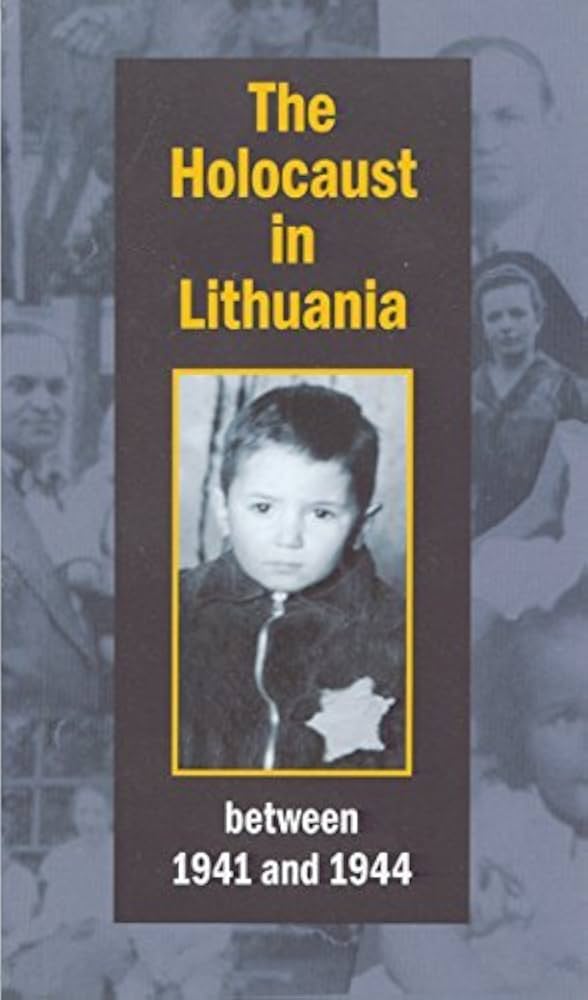
The Holocaust in Lithuania 1941-1944, edited by Arunas Bubnys. 2020. Genocide Resistance Research Center of Lithuania, Vilnius
Proven Jew Killer? Rarity of Local Collaborators. Notable Lithuanian Pushback At Holocaust Supremacism
This book provides much detail on the German-made Holocaust in Lithuania, and I emphasize seldom-discussed information. Do not assume a proven Jew killer. The lessons of this book can be applied to alleged Polish collaboration.
DO NOT DIMINISH COMMUNIST CRIMES! A BLOW AGAINST HOLOCAUST SUPREMACY
Jews have consistently berated the Lithuanian people for believing in double genocide–wherein Communist crimes are equal to the crimes of the Nazis (against Jews that is). Idzelis describes a courageous Lithuanian pushback against this transparent Holocaust supremacist idea, “The author is aware that the U.S. Department of State applied pressure on Lithuania to split the International Commission for the Evaluation of the Crimes of the Nazi and Soviet Occupation Regimes in Lithuania into two separate commissions. Lithuania resisted that pressure, confirming that both Soviet and Nazi crimes were parallel and, in fact, equal crimes against Lithuania, Western civilization, and humanity.” (p. 48). Absolutely. Bravo, Lithuanians!
Note also the U. S. government as a tool of Jewish interests, including those directed against other peoples. Now tell me again that there is no such thing as Jewish influence.
THE 1939 ZYDOKOMUNA WAS ANYTHING BUT MARGINAL
Jewish apologists and Zydokomuna denialists would have us believe that Judeo-Bolshevism was imaginary, or at worst innocent and insignificant. It was anything but. Author Idzelis drives home the point that it had a considerable impact upon the Soviet-conquered Lithuanian people! He writes, “Jews were particularly active in the Komsomol, the main political youth organization in the Soviet Union. Given the fanaticism and aggressiveness exhibited by many of its members, the Komsomol became the cutting edge of the Sovietization process in Lithuania. The zealousness of Komsomol members not only intimidated the general public – it also fed the growing anti-Soviet resistance in the country, especially among young people.” (p. 73. Emphasis added).
For more on the Jewish power and privilege in Lithuania, see:
RARE PROVEN JEW KILLER: LITHUANIAN KILLERS OF JEWS WERE UNCOMMON
Author Furmonavicius writes, “While it is clear that some Lithuanians did contribute, there is no evidence of general enthusiasm for the Nazi crimes, and even less of active participation by the general population. Holocaust researcher Adolfas Eidintas has argued with every appearance of being objective that some 2,000-3,000 Lithuanians can realistically be estimated to have participated in these appalling events, but he also acknowledges that the full facts of the matter are currently unresolved.” (pp. 39-40).
Let us keep the 2,000-3,000 in perspective. It means that only about 0.1%-0.2% of the Lithuanian people were killers of Jews. And so much for the Holocaust myth that the Germans could not have conducted the Holocaust without the massive assistance of the locals! For more facts and figures on Lithuanian collaborators, see:
For more on the mechanics of the killings of Jews, see:
DON’T EQUATE NAZI COLLABORATOR AND PROVEN JEW KILLER
Jonas Noreika is remembered in Lithuania as a heroic freedom fighter. Yet his granddaughter Silvia Foti has developed a mission to condemn her grandfather as a killer of Jews. [Have you ever heard of a Jew going around condemning his/her father or grandfather for being a Communist murderer? Laugh.]
What are the facts? Dainius Noreika writes, “…(Jonas) Noreika was neither an initiator nor an organizer of the mass killings, which were performed by the operational groups of the Nazi Security Police. Noreika did not arrest the victims, as this was done by members of the Lithuanian police. When Noreika was appointed to the Siauliai County administration, the Zagare ghetto had already been established…Noreika was a Nazi collaborator and participant in part of the Holocaust process; however, a collaborator and a murderer are not one and the same.” (pp. 100-101).
In other words, Jonas Noreika was definitely a Nazi collaborator but not a proven Jew killer. These are two different things! Note also that none other than the law recognizes a basic difference between a murderer and an accomplice (at worst) to murder. In this context, Jews do not.
As should be obvious, Jews are prone to mix different things up. Dainius Noreika adds, “…participation of the same person in the Holocaust, the Uprising, and the partisan war are separate phenomena of a different nature, revealing the complexity of the processes of the time, and showing that the same person could become a collaborator and a freedom fighter at different times. Unfortunately, such facts and considerations are largely alien to both Holocaust research and literature about Lithuania’s armed anti-Soviet resistance.” (p. 98). That’s for sure. It’s all Judeocentric.
EXPROPRIATING JEWISH PROPERTY: GERMANS GOT RICH, NOT THE LOCALS
Bubnys writes, “Jewish property was officially considered the property of the Third Reich. Part of the more valuable Jewish property (furniture, gold jewelry) was taken by German institutions, part was stolen by the murderers themselves, and the rest (clothes, small household items) was sold for a symbolic price or given free of charge to local residents.” (p. 314).
THE JEWISH GHETTO POLICE: NOT ALL CHOICELESS CHOICES
Bubnys writes, “Jewish policemen often took advantage of their official position (for example, demanding that Jews returning from the city give them food, or confiscating and appropriating residents’ valuables during searches) and even beat their fellow Jews. Like in other branches of the ghetto administration, the police force eventually became rife with corruption and protectionism. (p. 218).
In addition, Bubnys comments, “Most often, the ghetto police were blamed for their brutal and immoral behavior, corruption, appeasement of the Nazis, and arrogant stance with respect to ordinary ghetto residents.” (p. 225).
Bubnys also writes, “The majority of the ghetto residents viewed the Jewish police negatively, as a criminal body carrying out the orders of the occupation authorities.” (p. 233).

To see a series of reviews in a Category click on that Category:
- All Reviews
- Celebrate Poland's Heroic Narrative!
- Censorship Of Poles in Favor of Jews
- Communist and Nazi Crimes Equal. Stalin a Twin of Hitler
- Cultural Marxism
- Current Polish-Jewish Relations
- Follies of POLISH CENTER FOR HOLOCAUST RESEARCH
- German Polonocide in WWII
- German Repentance Jewish-Centered
- Holocaust Education Monopoly
- Holocaust Industry Propaganda
- Holocaust Industry Tactics
- Holocaust Myths
- Holocaust Was Not Special
- Holocaust-Centric Narratives Rule
- Ingratitude To Polish Rescuers of Jews
- Interwar Polish-Jewish Relations: Don't Automatically Blame Everything on Poles
- Jedwabne Provocation: German-Made Holocaust Expanded
- Jewish Collaboration With Nazis
- Jewish Economic Dominance
- Jews and Anti-Christian Tendencies
- Jews Antagonize Poland
- Jews Self-Otherize in Poland
- Media, Hollywood Polonophobia
- No "Civil War": Poland Communized By Soviet Russian Force
- No Polish Complicity in the Holocaust
- Persistent Anti-Polish Trends
- Pogroms Demythologized
- Polish Collaboration With Nazis Insignificant
- Polish Guerrilla Warfare
- Polish Nationalism: The Truth
- Polokaust (Polocaust) Long-Term
- Premodern Poland: Little-Known Facts
- Rescue of Danish Jews Demythologized
- Two Sides to Jewish-Goyish Antagonisms
- Ukrainian-Polish Relations
- Understanding Nazis and Jews
- Western European Threat and the European Union
- Zydokomuna in Action
- Zydokomuna in Jewish Life
