New Spotlight Trials of Nazis a Whopping Joke
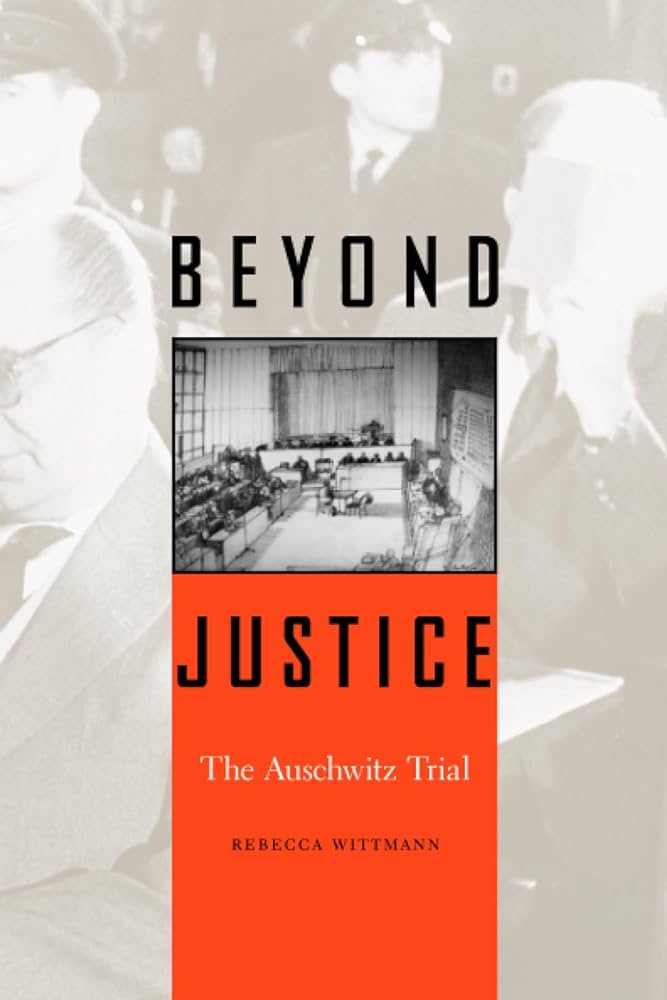
Beyond Justice: The Auschwitz Trial, by Rebecca Wittmann. 2005. Harvard University Press, Cambridge, Massachusetts and London, England
Trials of Nazis: Far From Exemplary German Repentance
This book focuses on the first Auschwitz trial of the mid-1960s. The reader is almost led to think that Jews were practically the only victims of the Third Reich.
TRIALS OF NAZIS: GERMAN PEOPLE UNWILLING TO CONFRONT THE NAZI PAST
Nowadays, Germany is held up as a model of repentance for Nazism, and this is used to attack Poland for comparatively trivial acts against Jews. Turns out that the “exemplary German repentance” is almost a joke. Wittmann writes, “Historian Dick de Mildt voiced similar sentiments, by pointing to a 1952 survey done by the U. S. High Commission for Germany which showed that only one in ten Germans wanted further Nazi war crimes trials. The survey stated that the “main reason for this much debated popular aversion was undoubtedly formed by the deeply rooted unwillingness among the German population at large to face up the vilest aspects of a political system they had so enthusiastically supported.'” (pp. 318-319. Emphasis added). Exemplary German repentance? Not in this universe!
Quite a bit has been said about the younger generation of Germans being repentant. Not quite. Wittmann remarks, “But the public lecture, and other discussions with young people, also unearned a different reaction. Many were impatient with the constant reminder of the atrocities committed against the Jews and the blaming of the German public through trials like the one in Frankfurt. Young people also argued that antisemitism was not solely a German creation, that many other countries also considered Jews the enemy and that, in fact, the Jews had brought this treatment on themselves.” (p. 263).
Note, once again, the exclusive focus on Jewish victims. And notice again the German blame-shifting: The reflexive impulse to equate the Nazi extermination of 6 million Jews with the comparatively trivial anti-Jewish acts done by other nations.
TRIALS OF NAZIS: ALLIED DE-NAZIFICATION POLICIES ALSO WERE HOLLOW
The author comments, “Recent analysis has generally contended that the hasty denazification and release of many investigated Nazis led to the continuation of conservative political trends and the preservation of powerful elites in both government and economy.” (p. 293).
TRIALS OF NAZIS: MINIMAL PUNISHMENT FOR GERMANS THAT COMMITTED HEINOUS CRIMES
Wittmann writes, “However one chooses to interpret the events of each trial and to assess the success each had in doing justice, the statistics regarding the actual trials of Nazis are dismal. Of approximately 100,000 people investigated in Germany and suspected of committing mass murder and participating in the machinery of the “Final Solution”, only about 6,500 were actually brought to trial, and the large majority of these before 1949.” (p. 5. Emphasis added).
Note from the above statements the usual pattern of judging Nazi crimes only against Jews. Non-Jewish victims are almost disregarded.
Other German trials were little better. The author comments, “Between 1950 and 1962 the West Germans investigated 30,000 former Nazis, indicted 12,846, tried 5,426, and acquitted 4,027. Statistics vary somewhat from source to source, but all show a relatively high figure for acquittals and a low number of heavy sentences. Of those sentenced, only 155 were convicted of murder.” (p. 15). Yes, jocular justice.
TRIALS OF NAZIS: NAZIS JUDGING NAZIS! WHY THE LENIENCY ON NAZI DEFENDANTS
Author Wittman asks, “Why was there such reluctance to pursue Nazi crimes, even the most heinous?…Historians and legal scholars have been grappling with the problems of Nazi trials in Germany, and with few exceptions, they conclude that Nazi crimes were not sufficiently punished or dealt with by the German judiciary.” (pp. 16-17. Emphasis added).
She answers her question, “…there was a great deal of continuity in the judiciary, such that many Nazi judges retained their posts in the postwar period and were therefore inclined to be very lenient with Nazi defendants.” (p. 16). She adds that, “Some argue that judges in post-war West Germany found ways to reduce convictions and sentences out of fear that they too would be investigated as former members of the Nazi party.” (p. 273).
Nazis judging Nazis: What a farce! And this is supposed to be exemplary repentance? Not in this universe.

To see a series of reviews in a Category click on that Category:
- All Reviews
- Celebrate Poland's Heroic Narrative!
- Censorship Of Poles in Favor of Jews
- Communist and Nazi Crimes Equal. Stalin a Twin of Hitler
- Cultural Marxism
- Current Polish-Jewish Relations
- Follies of POLISH CENTER FOR HOLOCAUST RESEARCH
- German Polonocide in WWII
- German Repentance Jewish-Centered
- Holocaust Education Monopoly
- Holocaust Industry Propaganda
- Holocaust Industry Tactics
- Holocaust Myths
- Holocaust Was Not Special
- Holocaust-Centric Narratives Rule
- Ingratitude To Polish Rescuers of Jews
- Interwar Polish-Jewish Relations: Don't Automatically Blame Everything on Poles
- Jedwabne Provocation: German-Made Holocaust Expanded
- Jewish Collaboration With Nazis
- Jewish Economic Dominance
- Jews and Anti-Christian Tendencies
- Jews Antagonize Poland
- Jews Self-Otherize in Poland
- Media, Hollywood Polonophobia
- No "Civil War": Poland Communized By Soviet Russian Force
- No Polish Complicity in the Holocaust
- Persistent Anti-Polish Trends
- Pogroms Demythologized
- Polish Collaboration With Nazis Insignificant
- Polish Guerrilla Warfare
- Polish Nationalism: The Truth
- Polokaust (Polocaust) Long-Term
- Premodern Poland: Little-Known Facts
- Rescue of Danish Jews Demythologized
- Two Sides to Jewish-Goyish Antagonisms
- Ukrainian-Polish Relations
- Understanding Nazis and Jews
- Western European Threat and the European Union
- Zydokomuna in Action
- Zydokomuna in Jewish Life
